

Blog

Latest News and Updates

nytimes.jpg

‘Great Comet’ Legal Battle

Three Words Lead to a Battle Over ‘Great Comet’ on Broadway

October 19, 2016

Five years ago, the small nonprofit theater company Ars Nova commissioned an up-and-coming composer to write his wacky dream project, a musical adaptation of one dramatic section of “War and Peace.”

On Tuesday night, that musical, “Natasha, Pierre & the Great Comet of 1812,” now a $14 million show starring the best-selling recording artist Josh Groban, had its first preview performance at the Imperial Theater — a major moment for Ars Nova, which has never before seen a project it birthed transfer to Broadway.

But the leadership of Ars Nova was not allowed to be there.

In a stunning and abrupt severing of an unusually close partnership, the nonprofit and the show’s commercial producers, closely interconnected by longstanding personal and financial relationships, are suddenly in a bitter battle over how the nonprofit’s role in the show’s development is credited in the show’s program.

Infuriated by the dispute, the show’s commercial producers have barred Ars Nova officials from the theater and threatened to prevent cast members from performing at the nonprofit’s big annual fund-raiser by scheduling the cast album recording on the same day, according to Ars Nova.

The schism has intensified sharply since it was first reported on Tuesday by The New York Post. Howard Kagan, a former Wall Street executive and a lead producer of the musical, has resigned from the board of Ars Nova, where he had been a top donor. And the nonprofit’s leadership, which had announced plans to honor Mr. Kagan and his co-producer wife, Janet, at its coming gala, instead on Wednesday took a step toward potential litigation, accusing Mr. Kagan of breach of contract and breach of fiduciary duty to the nonprofit’s board.

“We’re extremely hurt by everything that’s happened, and we feel that our work is being minimized,” said Jason Eagan, the founding artistic director of Ars Nova. “It’s particularly disappointing that it’s happening by one of our own board members.”

Matt Ross, a spokesman for the show, said neither he nor Mr. Kagan would have any comment, and he declined to make either the show’s creator, Dave Malloy, or its director, Rachel Chavkin, available to comment.

At issue are a mere three words: “the,” “production” and “of.”

Ars Nova says it was guaranteed, in a 2012 legal document, a copy of which it provided to The New York Times, that the Playbill would describe “The Great Comet” as “The Ars Nova production of” the show. An early draft of the Playbill did just that. But the actual program, now being distributed to theatergoers, does not include those words, instead listing Ars Nova above the title among the producers, and saying, in small type at the bottom of the title page, “originally commissioned, developed, and world premiere produced by Ars Nova.”

The language sought by Ars Nova has been used in programs for some other shows. In a 2013 revival of “Pippin” that was co-produced by the Kagans, the Playbill describes that show, above the title, as “The American Repertory Theater production of…”

In an interview Wednesday, Mr. Eagan said such language was a signal of Ars Nova’s role as an incubator for young artists: “It feels very important to us that people understand who we are, and what we do, and that it started here. That’s a very different thing than being lumped in with a group of financial backers.”

The dispute does not affect the financial agreement between the commercial producers and the nonprofit, which has been promised 1.5 percent of the weekly gross box office (increasing to 2 percent once the show recoups its capitalization, if that happens).

Several Ars Nova board members also stand to make (or lose) money as producers of the Broadway show; when the Ars Nova board met this week to discuss possible courses of action, those board members did not participate in the discussions. Mr. Eagan and another founder of the theater, Jenny Steingart, are also credited as producers, because they helped bundle investors for the show; Ms. Steingart is also an investor in the show.

It is not clear why Mr. Kagan opted not to use the agreed-upon language. According to Ars Nova’s managing director, Renee Blinkwolt, Mr. Kagan first notified the nonprofit of his desire to change the above-the-title billing on Oct. 9, and over a series of emails, phone conversations and meetings that followed the discussion became increasingly adversarial.

A lawyer representing Ars Nova, Richard A. Roth, on Wednesday sent Mr. Kagan a blistering letter accusing the Kagans’ production company of violating its contract with Ars Nova by changing the billing language, and accusing Mr. Kagan personally of breaching his fiduciary duty as an Ars Nova board member by threatening to initiate “a smear campaign in the press in order to irreparably harm Ars Nova’s reputation” as well as by harming its gala. The letter also accused Mr. Kagan of seeking to defame Ms. Blinkwolt.

“The Great Comet” was the largest and most expensive project ever undertaken by Ars Nova, and its initial run at the theater was quite successful; when the Kagans expressed an interest in giving the show a commercial life, Ars Nova was enthusiastic because of the couple’s commitment to preserve the show’s immersive nature — at each stage of the show’s development, theaters, including the Imperial, have been redesigned to look like Russian supper clubs, and seating has been rearranged so that audience members surround the dramatic action.

read more
Oliver‘Great Comet’ Legal Battle
nytimes.jpg

‘AN UPSET’ TOURS NYC AHEAD OF THE US OPEN

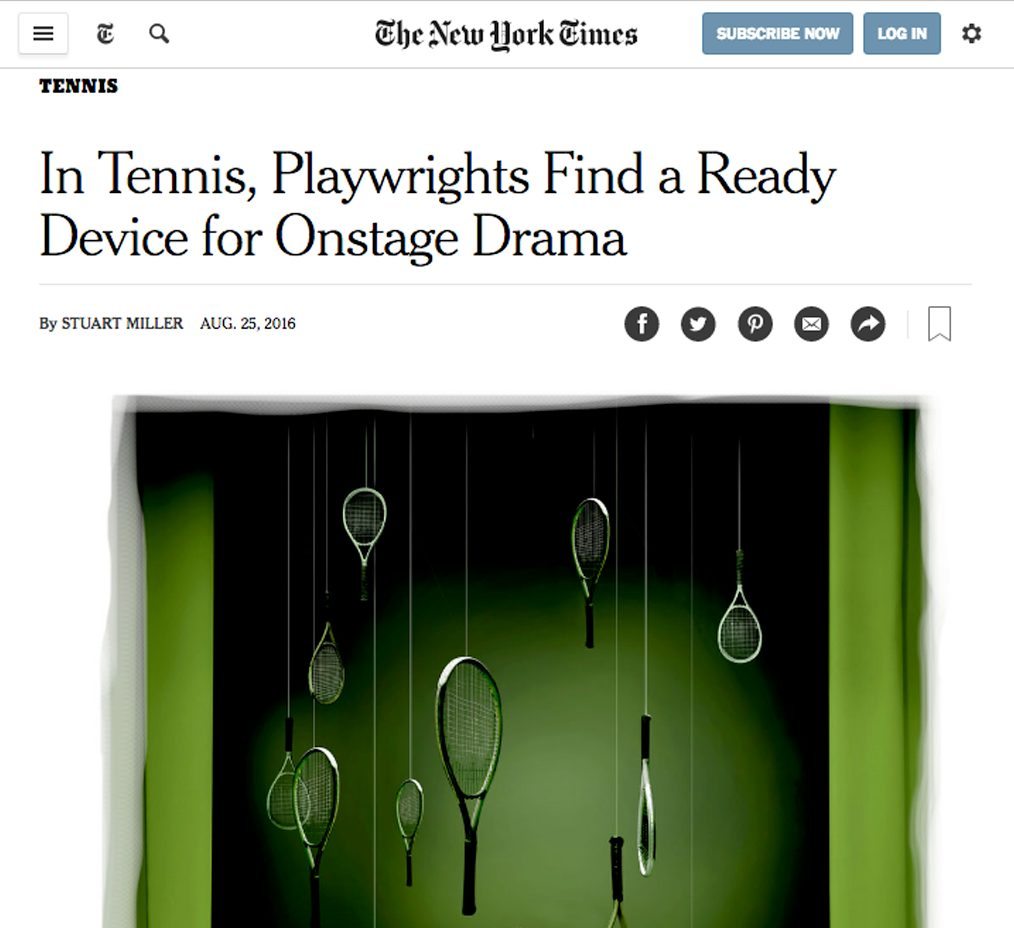
In Tennis, Playwrights Find a Ready Device for Onstage Drama

August 25, 2016

Stuart Miller

Andy Bragen raced to the net, hoping to capture a key point in the tight third-set tiebreaker. The results, initially at least, were calamitous. Mark Alhadeff whistled a passing shot by Bragen to widen his lead to 5-1. Losing the point was awful, but even worse for Bragen was the knowledge that Alhadeff was about to let loose with a self-congratulatory yell.

In that moment, Bragen could not tolerate the outburst, so he shouted across the net, “Don’t you say a word,” adding a vulgarity for emphasis. His opponent returned verbal fire, Bragen stomped off the court, and Alhadeff stormed home.

“Twenty minutes later he called me up, and he was sheepish, and I was sheepish,” Bragen said. “We both had talked to our girlfriends, who said, ‘What’s wrong with you?’”

All’s well that ends well, as Shakespeare might say. Bragen spent months recounting the incident to friends before turning it into a new play that takes its name from that vulgarity-laced on-court exchange. It opens in November at 59E59 Theaters.

While tennis takes center stage in New York this week with the start of the United States Open, the sport is also being depicted on stage with surprising frequency.

Sarah Ruhl’s new play, “Scenes From Court Life, or The Whipping Boy and His Prince,” will have its world premiere at Yale Repertory Theater on Sept. 30. It juxtaposes an extended early scene in which Jeb Bush and George W. Bush play highly competitive doubles with their parents with a scene in which Charles II, England’s king during the 17th century, plays royal tennis with his whipping boy.

Waiting in the wings is “The Last Match,” a play by Anna Ziegler that is set during a United States Open semifinal; it is scheduled to open in New York next year after runs in Pittsburgh and San Diego.

“An Upset,” a one-act play by David Auburn first seen in New York in 2008, is being revived around the city timed to the Open, including three shows at 99 Bowery beginning Sept. 12.

“It’s always hard to put a finger on why something is suddenly in the zeitgeist,” said Ruhl, a two-time Pulitzer Prize finalist and a Tony Award nominee. “I don’t know why it is happening with tennis in theater right now. But for me, while researching the Bush dynasty, I realized tennis is such a big part of their lives and a wonderful metaphor for family competition and sibling rivalry.”

In “Scenes From Court Life,” Greg Keller plays George W. Bush as a more shrewd politician than his brother Jeb but an inferior tennis player.

“Athletes are almost another species to playwrights,” Keller said. “The writer’s world is so subjective, but for athletes there is always a winner and a loser.”

Tennis holds undeniable appeal for the theater. For starters, it can encompass widely different settings, including the Bush family compound, the public courts of the Lower East Side and Arthur Ashe Stadium.

Tennis, Keller said, is also “one-on-one, but you are not physically touching each other like in boxing.”

He added, “You are in your own little world.”

Bragen has written other works about tennis, including a monologue called “Game, Set, Match.” He said the sport offered intimacy and isolation — great fodder for writers.

“There’s a kind of dance that I feel as a player, but you are alone in your own head at the same time you are connected to other person,” Bragen said.

Ruhl said she liked the combat mixed with decorum, “the formality within the structure of competition.”

Ryan Sweeney, who played Division I tennis at the University of California, Santa Barbara, and is producing and starring in “An Upset,” said, “Tennis is a lonely sport, and Auburn’s script touches on the players’ vulnerabilities.”

Tennis is also “a rich metaphorical landscape,” Ziegler said, whether one is writing about dynasties and power (Ruhl), the dynamics between friends and lovers or men and women (Bragen), or coming to terms with aging and the responsibilities of family (Ziegler).

“Plus, tennis is like life,” said Ziegler, whose “Photograph 51” won the award for best new play at this year’s WhatsOnStage Awards in London. “You are all alone out there, and it’s so unfair. The injustices of tennis mirror the injustices of life acutely — in tennis, you can win more points than your opponent and lose the match.

“Maybe the question is, Why isn’t everyone writing their tennis play?”

For practical purposes, no points in any of the plays will be played on stage; serves and rallies will be performed as stylized miming.

“We’re using narration and language to create the action for the audience, and it’s more exciting for it to happen in their imaginations than in a cinematic way,” said Lee Sunday Evans, the director of Bragen’s play.

In the first two productions of “The Last Match,” the actors did not even hold a racket, but they will do so in “Scenes From Court Life.” Ruhl said the director Mark Wing-Davey had wanted actors who knew how to play tennis.

It turns out there is a small but intertwined community of actors and playwrights competing on New York’s courts. Keller, the actor who plays George W. Bush, plans to take his racket to Connecticut to challenge Danny Wolohan, who plays Jeb Bush. Wolohan has played doubles tournaments in Brooklyn with the playwright Will Eno. Keller has, without incident, played against Alhadeff, who initially did readings for Bragen’s play in the part based on him.

“Mark had a loopy backhand, but after seeing it described in the play, he worked on it a great deal, and it’s better now,” said Bragen, who owns an orthodox but potent serve, a strong ground game and great court coverage but who, perhaps unsurprisingly for a playwright, can get stuck in his own head at crucial moments.

Bragen still hits with Alhadeff, although he said it had been “delicate” the first time they returned to the court. These days they rein in their emotions.

“We’re not in the caldron we were in before,” he said, now that both men have families. “I do have a kind of nostalgia for that intensity.”

Bragen indulges those emotions of “the inner 8-year-old” in the play, in which the feud grows much darker and deeper, dragging in both men’s girlfriends, who are the audience’s guides and the emotional linchpins of the play.

All the playwrights said writing the tennis scenes had come naturally.

“I wrote this at a time I was watching tennis obsessively,” said Auburn, whose play transpires in the locker room — “that’s where all the tension comes out” — after three tough matches between an aging American star and an up-and-coming Romanian.

Bragen said: “I’ve watched so much tennis over the years, the language is in my head. I think John McEnroe’s announcing is so psychologically astute, he should get some credit for these plays.”

Ziegler’s “The Last Match” pits Sergei Sergeyev, a talented and flamboyant young Russian who has not quite figured out how to win, against Tim Porter, a six-time United States Open champion who at 33 is rumored to be heading to retirement. In creating Sergeyev, Ziegler was inspired by the early career of Novak Djokovic of Serbia. Porter is an American version of Roger Federer, but both characters have hints of other players.

“Andre Agassi’s book was big for me, and Andy Roddick’s retirement speech did me in,” Ziegler said. “Watching someone at that age say goodbye to the life they’ve known made me think about what athletes go through in a much more accelerated way than the rest of us.”

Ziegler said that after she wrote the scenes between Sergeyev and his girlfriend and between Porter and his wife, the tennis scenes were suddenly invested with more emotion and higher stakes.

“You understood the intensity of the match because of what they have gone through to get to this point,” she said. “Then it became a much easier play to write.”

read more
Oliver‘AN UPSET’ TOURS NYC AHEAD OF THE US OPEN
broadwayworld.jpg

INDUSTRY READING STARRING CHILINA KENNEDY

Chilina Kennedy to Lead Industry Reading of New Musical ARE WE COOL NOW? This Week

June 7, 2016

Beautiful: The Carole King Musical star Chilina Kennedy will lead an industry reading of Are We Cool Now?, anindie rock road trip musical, in New York City on Thursday, June 9, 2016. Are We Cool Now? features music and lyrics by Dan Mangan with book by Amiel Gladstone.

Directed by Drama League Directing Fellow Mark Schneider and musical direction by Gramy Award winner Jason Howland and guitarist Kevin Ramessar (Jesus Christ Superstar, Beautiful: The Carole King Musical) with assistants Danielle Santos and Dana Savage. Are We Cool Now? also features P.J. Griffith (American Idiot, Mamma Mia!).

Inspired by and featuring the songs of Dan Mangan, Are We Cool Now? is a musical theater adventure following a couple who sets out on a road trip. Leaving it all behind forces the pair to reconcile with their place society and with their relationship to one another. This innovative piece of musical theater blends humor with intimacy to explore the inner workings of contemporary relationships.

Are We Cool Now? was presented with Western Canada Theatre in October 2015. This reading is produced by Oliver Roth of OHenry Productions.

read more
OliverINDUSTRY READING STARRING CHILINA KENNEDY
variety.jpg

‘AN UPSET’ IN BEVERLY HILLS


David Auburn’s Tennis Play ‘An Upset’ Comes to Beverly Hills

April 10, 2016

Dave McNary

David Auburn’s short play “An Upset” came to life Saturday night at a unique location — the iconic Sheats-Goldstein Residence in Beverly Hills.
“I was a semi-pro tennis player in France and Italy years ago and I just love the sport,” explained Ryan Sweeney, who is starring and producing.

Directed by Jeffrey Meek, Sweeney plays an older, argumentative American tennis pro who finds himself pitted against a younger Romanian player, portrayed by Troy Clevenger. Sweeney and fellow producers Chris Schembra and Andrew Sokolsky are planning for performances in Paris, London and New York with the goal of reaching the big screen eventually.

“There really hasn’t been a great movie about tennis and the play is so good — sort of an undiscovered gem,” Sweeney said after the performance concluded before several hundred on the tennis court.

Auburn won the Pulitzer Prize for his 2000 play “Proof,” which was adapted into a 2005 film starring Gwyneth Paltrow, Anthony Hopkins, Jake Gyllenhaal and Hope Davis.

Saturday night’s performance, held in honor of Easter Seals, marked the first play ever performed on the Sheats-Goldstein property, recently donated by owner James Goldstein to the Los Angeles County Museum of Art. The residence, built in 1963 by Frank Lloyd Wright disciple John Lautner, is known by film buffs as one of the key locations in the 1998 Coen Brothers film “The Big Lebowski.”

With its sweeping vistas and minimalist style, the house is often used for fashion shoots plus the occasional such celebration such as Rihanna’s birthday. Goldstein (pictured above with Schembra), an investor in real estate, said Saturday that he bought the residence in 1972 mainly because his Afghan hound Natasha needed more space.

“We were living in an apartment in West Hollywood so buying this solved that problem but this has been my passion,” he noted. “The house was not in the best condition when I bought it, so I brought in John Lautner to supervise and I’ve been involved in every aspect of construction ever since. I want the house to inspire great architecture.”

Goldstein’s other passions are often on display at Staples Center, where he has courtside seats for Lakers and Clippers games and wears designer outfits with a snakeskin hat. “I’m going to be on the road a lot going to playoff games in the next two months,” he added.

Sweeney said that Goldstein’s passion for tennis was essential to getting the play performed at the residence. “I think initially that he may have thought that I was Ryan Sweeting, who’s a ranked tennis player, but he’s been absolutely great at letting us perform this,” he added.

Schembra, who recently became a member of the board of the Easter Seals Foundation, has been active as a Broadway producer behind “The Little Flower,” starring Tony Lo Bianco. Saturday night’s event was curated through his charitable 747 Supper Club, which began last July and has held nearly 40 events as a means of combining food and community.

“We’re definitely going to take ‘An Upset’ on the circuit in the coming months because it’s such a good play,” he noted.

Read on Variety.com

read more
Oliver‘AN UPSET’ IN BEVERLY HILLS